












Infinix Smart 20 Review, Specs & Price in Nigeria.

Infinix Smart 20 Review, Specs & Price in Nigeria.
The Infinix Smart 20 is one of those phones that immediately makes sense when you look at the price. The Smart series has always focused on affordability and getting the basics right, but this time, Infinix seems to be pushing slightly beyond just “basic”.
And honestly, looking at what’s inside the phone, it’s difficult to ignore what Infinix is trying to do here.
You’re getting a large 120Hz display, a massive 5200mAh battery, Android 16 out of the box, IP64 splash resistance, expandable storage, NFC, reverse charging, and even some AI features. On paper, that already sounds like more than what most people expect from a budget device in 2026.
But of course, there are compromises too.
The cameras are average, charging is slower than it should be, and this is definitely not a phone for heavy gaming or performance-focused users.
So the real question is simple: Does the Infinix Smart 20 actually give enough value for the price it is being sold for in Nigeria?
After spending time with the device, here’s the full breakdown.
First Look & Unboxing Experience
One thing Infinix still gets right is the unboxing experience.
Once you open the box, you already have almost everything you need to start using the phone immediately. There’s a charging brick, USB-A to USB-C cable, SIM ejector tool, TPU case, paperwork, and the phone even comes with a screen protector already applied.
This matters to a lot of people, because a lot of brands are slowly removing accessories from the box, even on budget phones, so not having to spend extra money immediately after buying the phone is genuinely appreciated here. The case also matches the phone color, which is a nice touch.
It’s a simple unboxing experience, but practical.
Price in Nigeria & Variants
The Infinix Smart 20 comes in two storage variants in Nigeria:
- 4GB RAM + 64GB storage
- 4GB RAM + 128GB storage
The 128GB variant sits around the ₦160,000 range, while the lower storage version is ₦139,8000.
For a lot of people, the 128GB version is the safer option because apps, videos, and WhatsApp media already consume storage quickly these days.
Thankfully, Infinix also added a dedicated microSD card slot with support for up to 2TB expansion, so you don’t have to sacrifice your second SIM card just to add storage.
Design & Build Quality
The first surprising thing about the Smart 20 is how slim and lightweight it feels.
At around 7.7mm thin, it doesn’t feel bulky despite the large display and big battery inside. Holding it daily doesn’t feel stressful, and that balance between screen size and comfort is something Infinix handled well here.
The build itself is plastic, both on the frame and back panel, which is expected at this price point. But importantly, it does not feel cheap.
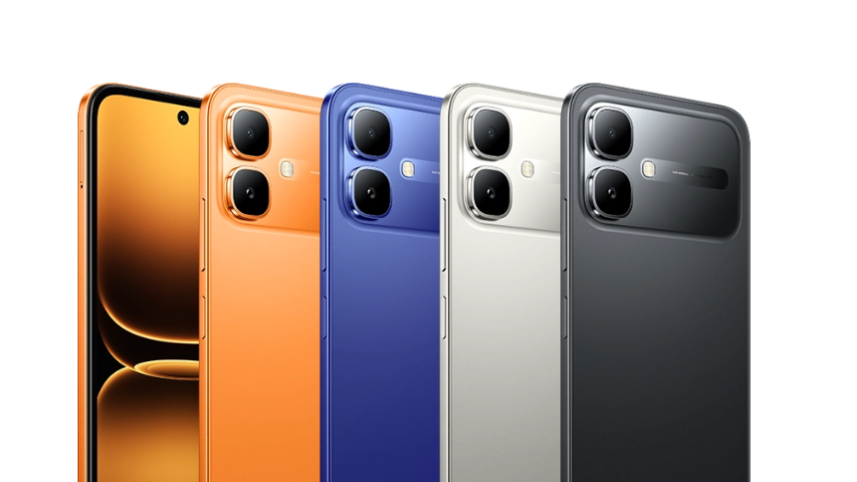
The rear design has a two-tone finish with a matte texture and a glossy camera section at the top. The glossy area picks up fingerprints easily, but overall, the phone still looks cleaner than what many people would expect from an entry-level device.
The Polaris Titanium color especially looks more premium than its price suggests.
There are also practical features here that are easy to overlook:
- Side-mounted fingerprint scanner
- Headphone jack
- IR blaster for controlling appliances
- Dual SIM support
- Dedicated memory expansion slot
The fingerprint scanner is fast and well-positioned, and the inclusion of an IR blaster is honestly useful for people who like controlling TVs or air conditioners directly from their phone.
Another important addition is the IP64 rating. Now, this does not mean the phone is waterproof. But it does mean it can handle dust and light water splashes better than many entry-level phones around this price.
If rain touches the phone slightly or water splashes on it accidentally, you’ll most likely be fine.
That extra layer of protection is practical for everyday use.
Display Quality
The display is one of the strongest parts of this phone. You’re getting a large 6.78-inch IPS LCD panel with a 120Hz refresh rate and up to 700 nits brightness.
For a budget phone, that immediately stands out.
Now, realistically, you won’t be getting full 120Hz across everything. Most apps run closer to 90Hz, with only selected apps fully using the higher refresh rate. But even at 90Hz, scrolling feels smoother than many other phones in this category.
The resolution is HD+ (720 x 1576), and yes, a 1080p panel would have been nicer. Especially in 2026 where more devices are moving towards higher resolutions.
But once you start using the phone daily, the lower resolution becomes less noticeable than expected.
The thin bezels and large screen help the phone feel immersive, and color reproduction is surprisingly decent for the price. Watching YouTube, movies, or social media content actually feels enjoyable here. Viewing angles are also solid.
The main weakness of the display shows outdoors under harsh sunlight. At 700 nits brightness, visibility is manageable, but you’ll still struggle slightly under direct afternoon sun.
Still, for the price, this is a good display experience overall.
Performance & Everyday Usage
The Infinix Smart 20 is powered by the MediaTek Helio G81 Ultimate chipset paired with 4GB LPDDR4X RAM. And, for regular everyday use, the phone performs fine.
Apps open reasonably quickly. Scrolling through Instagram, WhatsApp, TikTok, YouTube, Chrome, and other daily apps feels smooth enough for the average user.
Where the limitations start showing is gaming. Casual games are okay, but heavier titles like Call of Duty Mobile will push this chipset harder than it can comfortably handle.
Storage also uses eMMC 5.1 instead of faster UFS storage found on more expensive phones. That means app loading times and file transfers are slower compared to mid-range devices.
But again, for basic users, the difference may not even matter much.
Software & Features
The Smart 20 runs Android 16 with XOS 16 out of the box, which is genuinely impressive at this price point. A lot of entry-level phones still launch with older Android versions.
There’s still some bloatware pre-installed, and that remains one of the weaker parts of the experience. Thankfully, most of the apps can be removed or disabled.
Infinix also added a few useful software features:
- Ultra Link 2.0
- AI Image Eraser
- AI Writing Assistance
- Noise cancellation for calls
Ultra Link is especially interesting because it allows communication between compatible Infinix devices without internet or SIM connection at short distances. For areas with unstable networks, that could genuinely be useful.
The software overall feels cleaner than older Infinix phones, and XOS has improved noticeably over time.
Camera Performance
The Smart 20 uses a single 8MP rear camera and an 8MP selfie camera. In good lighting, photos are decent enough for social media and everyday use. Outdoors during the day, images come out usable with acceptable colors and detail. But once lighting drops, the camera quality drops quickly too.
Video recording supports up to 2K at 30fps on both front and rear cameras, which is impressive for the price. However, there’s no stabilization. So if you move while recording, footage becomes shaky very quickly.
For casual videos and everyday moments, the cameras are fine. But if photography or content creation matters heavily to you, there are stronger camera options around this price range, and you can check them out on our website here.
Battery Life & Charging
You can say goodbye to battery anxiety here. The 5200mAh battery is easily one of the best things about this phone. For most users, this phone comfortably lasts a full day, and lighter users can even push beyond that.
Charging, however, is slower than it should be. The phone supports 15W charging but ships with a 10W charger inside the box. Charging fully takes slightly over two hours.
Final Verdict
The Infinix Smart 20 gets a lot of the important things right for everyday users. You’re getting a large smooth display, reliable battery life, decent software experience, expandable storage, modern features like IP64 resistance and NFC, and a design that genuinely looks better than what the price suggests.
If your priority is getting a phone that handles daily tasks comfortably without draining your wallet, the Smart 20 makes a strong case for itself.
Full Specifications
| Network | Technology | GSM / HSPA / LTE |
| Body | Dimensions | 167.7 x 78.8 x 7.7 mm (6.60 x 3.10 x 0.30 in) |
| Weight | – | |
| Build | Glass front, plastic back, plastic frame | |
| SIM | Nano-SIM + Nano-SIM | |
| IP64 dust tight and water resistant (water splashes)Drop resistant up to 1.5m |
| Display | Type | IPS LCD, 120Hz, 700 nits (HBM) |
| Size | 6.78 inches, 109.5 cm2 (~82.9% screen-to-body ratio) | |
| Resolution | 720 x 1576 pixels, 19.5:9 ratio (~259 ppi density) |
| Platform | OS | Android 16, XOS 16 |
| Chipset | Mediatek Helio G81 Ultimate (12 nm) | |
| CPU | Octa-core (2×2.0 GHz Cortex-A75 & 6×1.7 GHz Cortex-A55) | |
| GPU | Mali-G52 MC2 |
| Main Camera | Single | 8 MP, f/2.0, (wide), 1/4.0″, 1.12µm, AF |
| Features | Dual-LED flash, panorama | |
| Video | 1440p@30fps, 1080p@30fps |
| Sound | Loudspeaker | Yes |
| 3.5mm jack | Yes |
| Comms | WLAN | Wi-Fi 802.11 a/b/g/n/ac, dual-band |
| Bluetooth | Yes | |
| Positioning | GPS | |
| NFC | Yes | |
| Infrared port | Yes | |
| Radio | FM radio | |
| USB | USB Type-C 2.0, OTG |
| Features | Sensors | Fingerprint (side-mounted), accelerometer, proximity, compass |